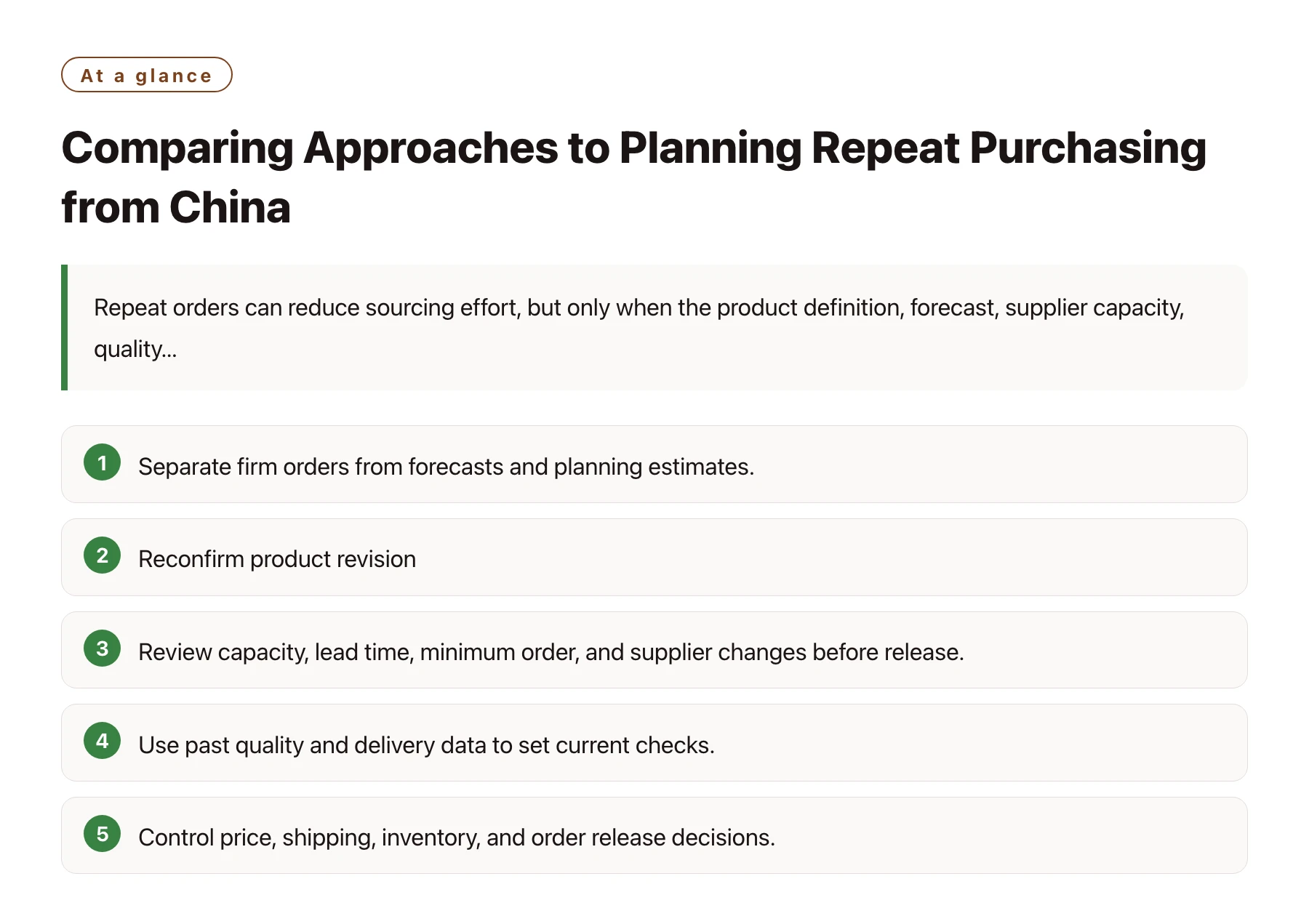
Repeat orders can reduce sourcing effort, but only when the product definition, forecast, supplier capacity, quality feedback, and delivery assumptions remain current. A previous successful order is evidence about one configuration and period; it does not guarantee that the next lot will match or arrive on the same schedule.
Key takeaways
- Separate firm orders from forecasts and planning estimates.
- Reconfirm product revision, materials, labels, packaging, and market evidence.
- Review capacity, lead time, minimum order, and supplier changes before release.
- Use past quality and delivery data to set current checks.
- Control price, shipping, inventory, and order release decisions.
Treat each order as a controlled release while using past performance to improve the next decision.
1. Decide what is genuinely repeatable
Identify products, variants, components, and packaging that can be reordered without redesign. Confirm drawings, bill of materials, accepted substitutes, labels, inspection criteria, and market documents remain current. Mark items that require fresh review after time or regulation changes.
Maintain one approved specification revision and link each order to it. A similar product name or photo should not be treated as proof that the factory has kept the same construction.
Check component availability and document any approved alternate sources. Identify which options were accepted on an earlier order and whether that approval remains valid. If the product has seasonal demand or a long replenishment cycle, include forecast confidence and the cost of holding stock in the release discussion.
2. Distinguish forecast from commitment
Share forecast ranges and timing for capacity planning, then issue a separate purchase order for firm quantity, price, delivery, and revision. State the validity period of forecasts and how changes will be communicated.
Avoid asking the supplier to reserve material or capacity without clarifying whether it is a binding commitment, paid reservation, or planning estimate. Record cancellation, postponement, and overage rules in the commercial agreement.
Share a rolling forecast with a stated horizon and update frequency. Mark quantities as estimates until the buyer issues a firm order. This helps the supplier discuss capacity without confusing a planning signal with a commitment to buy.
3. Recheck capacity and lead time
Before each release, ask for current component availability, production loading, subcontractor dependencies, tooling condition, and realistic lead time. Compare stated capacity with previous actual performance and the new order size.
If demand changes, ask for a revised schedule and identify which milestones move. Do not carry forward an old lead-time estimate when materials, factory loading, season, or product version has changed.
4. Review supplier performance using evidence
Compare on-time delivery, inspection results, defect recurrence, corrective-action closure, document accuracy, and responsiveness across orders. Look for trends by product and factory rather than one overall rating.
ISO 9001:2026 specifies requirements for quality management systems. Supplier system evidence can inform process review, but repeat-order acceptance still depends on this order’s product checks and commercial requirements. [1]
5. Reassess product and market changes
Check whether components, materials, factory, subcontractors, labels, packaging, destination, or market rules changed since the previous order. Request updated declarations, reports, or samples if a change could affect fit, safety, performance, or compliance.
The importer’s qualified compliance owner should determine whether new evidence or authorization is needed. Do not assume a prior shipment establishes current market status for every future product configuration.
6. Balance inventory and delivery risk
Compare order frequency, safety stock, storage cost, obsolescence, minimum order, shipping mode, and stockout impact. Use demand history and forecast uncertainty to select a practical order cadence. Agree who bears risk for excess materials or finished goods.
For international delivery, state the chosen trade rule and named place precisely in the contract. Incoterms® rules clarify buyer and seller tasks, costs, and risks; they do not replace the full sales contract or product requirements. [2]
7. Preserve repeat-order quality controls
Review prior defects and decide whether checks should be retained, changed, or intensified. Specify lot identity, sample selection, visual and functional criteria, report deadlines, and release authority for the new order.
A golden sample can help with appearance, but it cannot cover changed materials or hidden performance characteristics by itself. Confirm whether a new first-off sample or process check is needed after long gaps or significant production changes.
8. Compare commercial approaches
Option A may use smaller, more frequent orders; option B may reserve capacity or consolidate larger volumes; option C may hold buyer-owned inventory or components. Compare cash flow, unit price, storage, forecast risk, lead time, transport, and cancellation terms using the same assumptions.
Ask suppliers to itemize price validity, volume tiers, material ownership, tooling maintenance, payment timing, packing, and service. Recheck exchange-rate or freight assumptions instead of copying old landed-cost calculations without review.
9. Create a repeat-order release checklist
Before releasing, verify specification revision, quantity, price, capacity, schedule, market documents, labels, packaging, quality plan, delivery rule, and named approvers. Attach unresolved risks and due dates to the order.
Buyers comparing Shanghai JS Sourcing can ask how ongoing supplier communication, order tracking, inspection, and shipment coordination would work for their forecast pattern. Keep the buyer’s decision authority explicit and review the process after each delivery.
Sources
Frequently asked questions
Can a successful first order guarantee a successful repeat order?
No. Reconfirm product revision, materials, factory, market evidence, capacity, and current production controls for every order.
Should forecasts be treated as purchase orders?
No. Label forecasts as planning estimates and state separately when quantity, price, and delivery become firm.
What supplier data helps plan repeat orders?
Review actual lead times, capacity, defect trends, corrective actions, document accuracy, and responsiveness across comparable orders.
When should a repeat order require a new sample?
Request one after a product, factory, material, process, market, or long-gap change that could affect conformity.